

“Reality is one, though wise people speak of it variously”, Rig Veda, c 1000 BCE
How can we make the most of academic disciplinary knowledge to understand complex cross-cutting issues?
Here I suggest a format for events that could help us better grip the many dimensions of everyday issues - from wars to economic crises, weather patterns to social conflicts - an approach that is particularly relevant to universities that often have brilliant academics within disciplines, but sometimes struggle to combine their knowledge into more comprehensive and useful views of the world.
To the man with a hammer everything looks like a nail, and something similar happens with academic disciplines. What’s suggested here is a method to help people understand, and act more effectively, on the complex, many-sided problems that surround us.
Elephants - seeing in the round in 360°
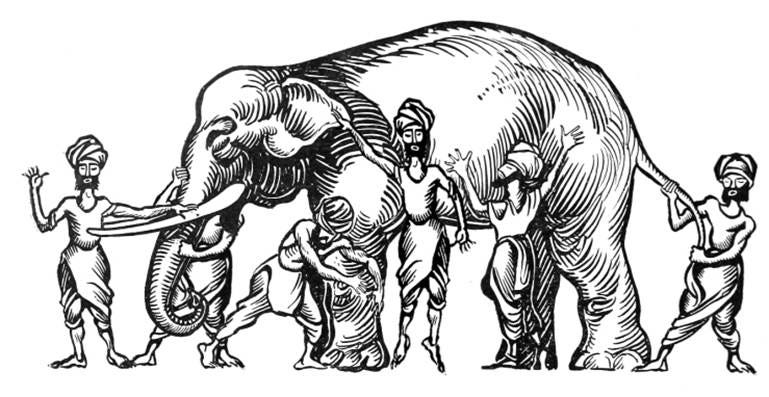
The ancient Indian story of the blind men and the elephant provides a good starting point. The story – whose earliest form is a Buddhist text from around 500BC - has spawned many variants, but its core involves a group of blind men who have never encountered an elephant before. Each gets a chance to touch one part of it and then tries to describe what the object is.
One touches the trunk and concludes it’s a thick snake. Another touches the ear and thinks it’s a kind of fan. A third feels the leg and concludes it’s a tree trunk. A fourth feels the side of its body and says it’s a wall. The man who touches the tail says it’s a rope while the man who touches the tusk describes it as a polished spear. In some versions each then concludes that the others are liars. Yet each is doing their best from their limited perspective. It just happens that their perspective is partial and misleading.
Suitable topics for discovery circles
To see the elephant as it really is requires multiple perspectives. So the proposed events – which we could call ‘discovery circles’ – aim to generate a composite and more accurate picture of an issue, seeing things in the round, and ideally leading to a synthesis of diverse viewpoints.
In the simplest version you invite a group of academic and other experts to discuss a topic, each presenting first from their own vantage point, and then discussing the overlaps and differences, moving closer to synthesis.
There’s no shortage of topics this could work for. One source is the many complex issues that make up the daily news. Understanding issues from war in the Gulf and Ukraine, to the regulation of AI or net zero, demands multi-disciplinary perspectives, even though the ways they are presented in the news often flatten out the complexities. In the case of a war, for example, the potential inputs can come from historians, political scientists, international relations experts, military strategists, economists, engineers, computer scientists and psychologists, as well as experts in literature.
Other strategic challenges provide another source of topics. For example, falling birthrates around the world can be analysed through many lenses: economic, social, psychological, with some emphasising the role of social media in promoting singledom, and others financial and housing pressures and others still changing gender patterns in the workforce (my recent piece for IDB discusses many of these).
Cutting carbon and going to net zero can be understood through the lens of engineering, the science of emissions, the psychology of behaviour change, the economics of incentives and regulations, the perspective of law and regulation or campaigning, the politics of backlashes. Riots and community conflict can be understood through the lens of history, crowd psychology, demographics, economics, urban design, sociology, political science and community organising. So can political polarisation, air quality, teenage mental health: all are good candidates.
There are then more abstract examples such as: ‘how should a society imagine its possible futures’ or ‘how should a society handle a new general purpose technology’: again these can be grasped through philosophy, literature, psychology, the history of science and futures studies and other disciplines, in each case generating a richer composite view of the issue.
Structuring discovery circles
My suggestion is to structure events, perhaps 90 minutes or a couple of hours long, and ideally with food and drink, but bearable on zoom or teams, in the following way:
First, a moderator introduces the topic: what is the question, why it matters, where the world stands now.
Next, half a dozen experts from different angles describe how their discipline, profession or lived experience understands it – taking no more than 7-8 minutes each, with pictures if possible (and ideally with short written contributions in advance).
Then, after that, each speaker should get a chance to comment on each other speaker for a couple of minutes, to identify potential convergences or divergences.
The next step could gather comments and questions from the audience. What’s convincing? What’s missing? What are points of overlap? In a suitable space the group could be broken up into small groups of 6-10, before returning to a plenary format. AI can increasingly be used to record these conversations and map areas of consensus and disagreement; provide inputs of facts or evidence; and suggest new syntheses. A live visualisation of the key points can help here too – and many brilliant artists now do this well, and fast.
Next, each initial speaker should be given a chance to share how their understanding has been changed
Finally there would be a closing wrap up at the end by someone, a team or a mix of people and AI, tasked with thinking about synthesis (synthesising upwards, downwards, forwards etc), what’s been discovered and unresolved questions that could be resolved with new data or experiments.
The approach is circular in several senses - first it aims to see the topic from all angles, and second it encourages the participants to circle around the issue, deepening their understanding with each turn.
It’s a very simple idea. But since wisdom often starts from seeing multiple perspectives it could be very useful, as well as fun and educational.
This approach can also be used to guide academic work. I recently published a survey of how 12 different disciplines could contribute to the design of future institutions, suggesting the contribution of each.
As a relatively recent university joiner I’ve been surprised how little serious interdisciplinarity there is partly perhaps a reflection of the relative power of individual disciplines, and partly because it’s not clear whose job it is in a university setting to focus on transdisciplinary work and synthesis. Such methods are also rare in politics (Select Committees could use them, for example), and in the media, which more often defaults to a couple of experts giving brief comments with little interrogation of their views.
The aim of ‘discovery circles’ should be that by the end of any gathering everyone has a richer, more sophisticated understanding of issues: everyone should have discovered something new. But there’s also another, just as important, aim: to encourage academics to think across disciplinary boundaries, to become adept at synthesis and to resist the strong pressures that push them to prioritise publishing in academic journals over the search for profound insights. This must be healthy both for universities and for the societies they are part of.
Annex: The question of ‘NEETs’ as an example.
NEETs (young people not in employment, education or training) provides a good example of how this kind of exercise can be done. The question of how to reduce the number of NEETs is very live again in the UK (25 years ago I oversaw a UK government review of NEETs, ‘Bridging the Gap’ which prepared a batch of policies to help young people into jobs and education, but the numbers have gone up again recently).
It’s a topic on which there are many competing diagnoses and prescriptions, mainly because people start from very different perspectives and premises. The many very different explanations for why teenagers drop out of school, underperform or fail to get jobs, and reflect the assumptions of different disciplines. These various diagnoses emphasise:
· disincentives and low pay or access to entry level jobs;
· a curriculum that isn’t motivating for some young people;
· poor teaching, or poor school performance at 11;
· family influence;
· peer influence;
· shifting gender identities;
· social media/cultural influences;
· mental health and so on.
There is some supporting evidence for each perspective which come from economists, psychologists, sociologists, educationalists, and young people themselves, and all point to different potential solutions, some emphasising what happens in classrooms, others financial incentives and job opportunities, others still coaches, mentors, family or regulation of the media environment. Some of the issues echo the remarkably stale debate about whether school education should emphasise knowledge or skills (the clear answer from evidence is ‘both’, but many broadsheet commentators still believe these are mutually exclusive chioces).
Others echo the somewhat more nuanced debate about the effect of minimum wage levels on job creation. And some engage seriously with the role of harder-to-measure non-cognitive skills, like ability to work in teams, communication and confidence, that are particularly important for employers, but still often ignored by educational decision-makers.
With enough time these different perspectives can be gathered together in systems maps that chart the strength of evidence behind each diagnosis and where power lies to act (this was a standard method in the Strategy Unit, for example, described in more detail here).
For relatively short events, full-scale systems maps aren’t viable. But a rough approximation can be achieved even in relatively short sessions, mapping the different claims about causation and how convincing the data and evidence are to back them up.
The aim should then be a circling process, constantly asking about confidence levels, or what evidence would confirm or disprove claims, or what the granularity of the claim might be (since often the claim will be accurate about a sub-group but not accurate as a generalisation), in order to inform a synthetic policy approach that might include some new national laws, rights and programmes, but also plenty of experiments to test out promising ideas, and to make the most of local creativity.
In my last post I described the potential for what I call ‘knowledge twins’ that orchestrate these different kinds of knowledge much more systematically. These too are essential for understanding issues like NEETs. But some variants of ‘discovery circles’ are a good starting point too.
[Geoff Mulgan’s book ‘Exploratory Social Science’ is published by Oxford University Press later this year]
Hi Geoff
SCiO - the professional body for systems and complexity practitioners has recently launched a think tank applying basic systems principles to societal level problems. https://42systemicreview.org/
You might find the recent review on NEETs interesting: https://42systemicreview.org/papers/the-lost-boys-neets/
Its quick easy, and free. Happy to collaborate if that's of interest?
A list of all the ideas that could help solve a particular problem is a good first stage.
The next stage is what weight should be given to each idea and this then raises what are the criteria to be used.
Governments usually have too many priorities and too many documents that suggest all the things that need to be taken into account before a final decision is made and work on delivery can begin.
With political parties of the left there is a danger that equality of opportunity becomes equality of outcomes. For example, Summer internships with the civil service are now limited to " Working class " applicants and for MI 5 they also need to be from an ethnic background.
In the case of NEETS, projects that favour those from disadvantaged backgrounds may result in the economic improvement hoped for being less than it could be if those from more affluent backgrounds were chosen.
Employers in the private sector generally seek to recruit workers that will add the most value. The public sector may use different criteria that will add less value which is not the right way to boost growth.